NMR for structure determination of powders
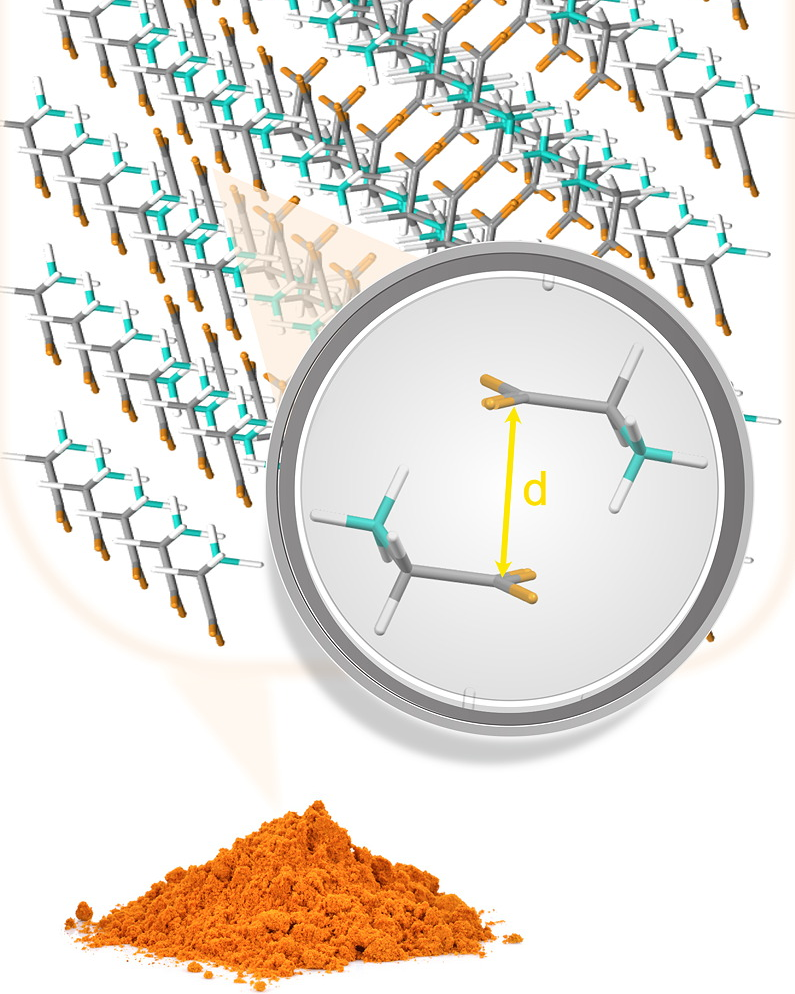
Polymorphism – i.e. the ability of a chemical compound to crystallize in different forms – is a phenomenon ubiquitous in organic solids, but still poorly understood. Because different polymorphs of the same chemical compound have radically different physicochemical properties, polymorphism can have enormous economic and practical consequences for many industrial applications (e.g. in pharmacy). One of the major experimental challenges consists in finding structure-property relashionships. However, accessing the atomic-level structure of polymorphs is complicated when crystallites are small (sub μm), as it happens for powdered samples.
To meet these challenges, our team works on the development of new experimental approaches in NMR crystallography, which, combined with computational methods, gives access to the atomic-level structure of powdered organic solids. Specifically, we develop new experimental tools based on solid-state NMR coupled with Dynamic Nuclear Polarization (DNP), which increases the NMR sensitivity of several orders of magnitude.
This project is supported by:
Associated members
Collaborators
Associated publications
A Karplus equation for the conformational analysis of organic molecular crystals
P. Thureau, I. Carvin, F. Ziarelli, S. Viel, G. Mollica*
Angewandte Chemie International Edition, 58 16047-16051 (2019)
Reducing the computational cost of NMR crystallography of organic powders at natural isotopic abundance with the help of 13C-13C dipolar couplings
P. Thureau, S. Sturniolo, M. Zilka, F. Ziarelli, S. Viel, J. R. Yates, G. Mollica*
Magnetic Resonance in Chemistry, 57 256-264 (2019)
Quantitative Structural Constraints for Organic Powders at Natural Isotopic Abundance Using Dynamic Nuclear Polarization Solid-State NMR Spectroscopy
G. Mollica, M. Dekhil, F. Ziarelli, P. Thureau, S. Viel
Angewandte Chemie-International Edition, 54 6028-6031 (2015)
Probing crystal packing of uniformly 13C-enriched powder samples using homonuclear dipolar coupling measurements
G. Mollica, M. Dekhil, F. Ziarelli, P. Thureau, S. Viel
Solid State Nuclear Magnetic Resonance, 65 114-21 (2015)
A facile approach for estimating radio-frequency field strength of low-receptivity nuclei
Nghia Tuan Duong, Stéphane Viel, Fabio Ziarelli, Pierre Thureau, Giulia Mollica
J. Magn. Reson., 358 107614 (2024)
nutation curve by varying the pulse length in a direct single-pulse excitation experiment or in a cross-polarization
magic-angle spinning with a flip-back pulse experiment. From the null points on this curve, one can calculate the
RF field strength. Nevertheless, the practical implementation is not always straightforward or can even be unrealizable,
especially for low-receptivity nuclei owing to their associated low sensitivity. Several researchers used
an approach that involves utilizing other nuclei with more sensitivity but nearly identical Larmor frequencies to
that of the nucleus of interest. However, such an approach has not been a common practice so far. In this work,
we have systematically revisited this approach using 3.2 mm rotors on different sets of nuclei covering a Larmor
frequency range up to 80 MHz. The effect of solid- and solution-states on RF field strength measurements has
been investigated. The detection of each set of nuclei is then carried out with a resonant circuit in the NMR probe
consisting of identical coils and capacitors. Our methodology is illustrated by recording 135/137Ba NMR spectra of
BaTiO3 without prior 135/137Ba RF field calibration.
giulia.mollica@univ-amu.fr